Zero-click search is a Google search that ends without the user clicking through to any website. The person gets what they came for — an answer, a phone number, opening hours, a map, a set of reviews, or an AI-generated summary — right there on the results page. It is now how most Google searches end, and it quietly changes what "doing well on Google" means for a local business.
Key takeaways
- In SparkToro's 2026 analysis, fewer than one in three Google searches still send a click to the open web — most now end on Google itself.
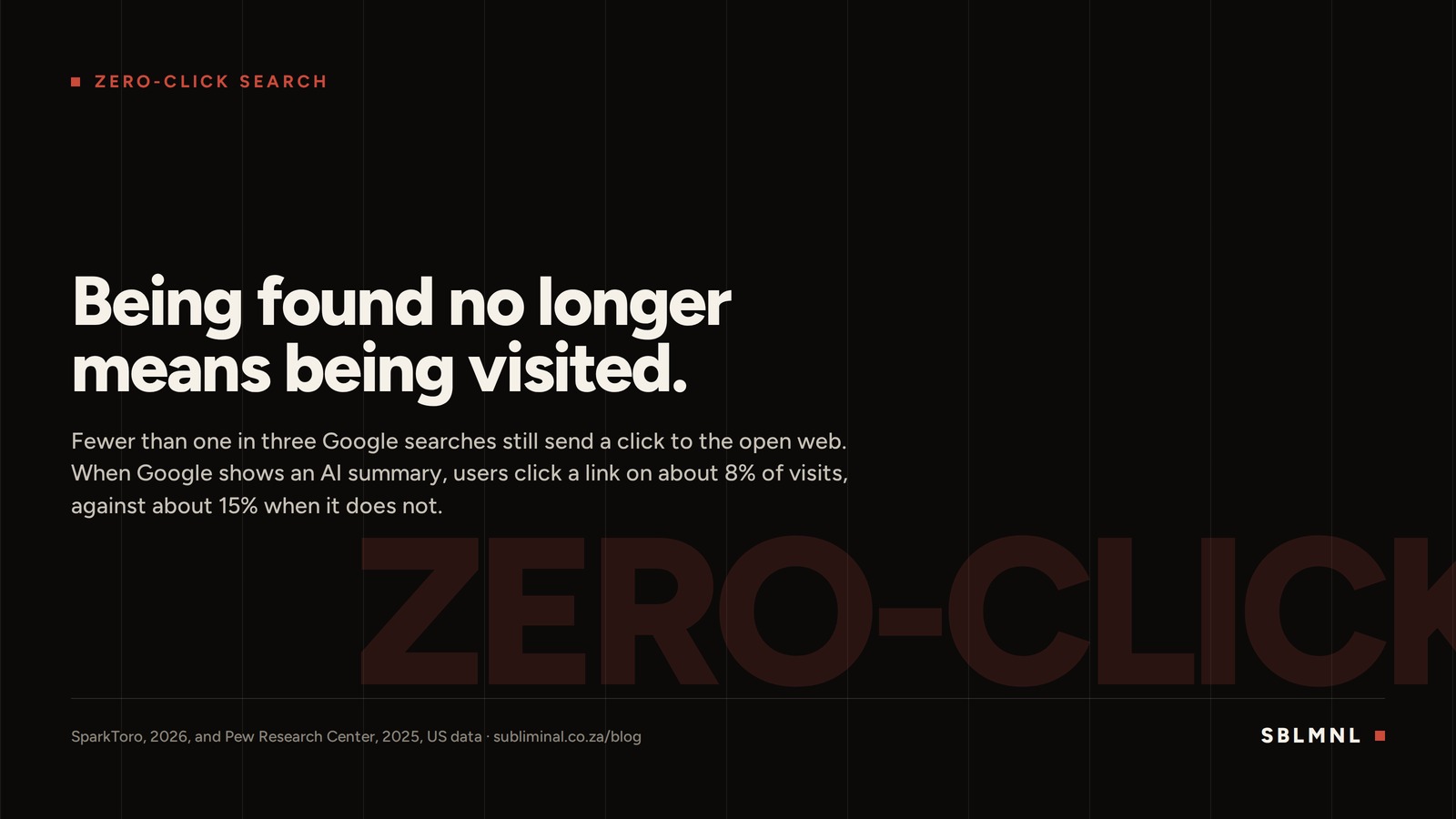
- When Google shows an AI summary, users click a website link in about 8% of visits, versus about 15% when there's no summary — roughly half (Pew Research Center, 2025, US data).
- Being found no longer means being visited: raw website traffic is a weaker measure of visibility than it used to be.
- Google states plainly that reviews and ratings help local ranking — and that local ranking cannot be bought.
- For most businesses, the fastest gains come from an actively managed Google Business Profile and a steady flow of genuine reviews.
What "zero-click" actually means
For years the scoreboard was simple: more website visits meant more visibility. That link has loosened. In SparkToro's widely-cited analyses of Google clickstream data, the share of searches that end without any click to the open web has climbed year on year — their 2024 study found that for every 1,000 US Google searches only about 360 clicks reached the open web, and by their 2026 analysis fewer than one in three searches still send a click to the open web.
The reason is that Google's results page increasingly answers the question itself — with a business's details, a map, reviews, and, more and more, an AI-generated summary at the very top. These features have rolled out well beyond the US, so while the cleanest measurements are American, the shift shows up wherever Google operates, South Africa included.
Being found is no longer the same as being visited
The effect is sharpest when Google shows an AI summary. A Pew Research Center study of 900 US adults, published in 2025, found that when an AI summary appeared, people clicked a traditional search-result link in just 8% of visits — against nearly 15% when no summary was shown. Clicks to the sources cited inside the summary were rarer still, at around 1% of visits.
The customer still makes a decision; they just make more of it before any click happens. So the useful question is no longer only "how much traffic does my site get?" It is "when someone searches for what I do, what does Google actually show them about my business — and is it any good?"
The good news for well-run businesses
Here is the part that tends to get lost in the worry about AI: the things Google leans on to decide who to show are, increasingly, the things a genuinely good business already has.
Google says so in its own guidance. Its official advice on improving local ranking states that "more reviews and positive ratings can help your business's local ranking" — and, just as plainly, that "there's no way to request or pay for a better local ranking on Google." Placement in local results is not for sale. A smaller business with genuinely strong reviews and a well-kept profile can appear above bigger spenders.
For the first time, in other words, doing great work is the visibility strategy — provided it is actually visible. The businesses that lose out are not the ones without big budgets; they are the ones whose real-world reputation never made it online.
Where to focus first
Two things do most of the heavy lifting, and both are among the most easily neglected:
- Your Google Business Profile. Often the first thing a prospective customer sees, and what AI-powered recommendations increasingly draw on. Claimed, verified, and kept current, it does a surprising amount of the work of getting found, which is the whole point of the discipline of Google Business Profile Management.
- Your reviews. Most businesses have a loyal base of happy customers, yet very little of that goodwill is reflected online. Asking every customer, consistently, turns real-world reputation into something future customers — and Google — can actually see.
A well-built website still matters — it's how you earn a place in the searches and AI answers that reach beyond the local pack, which is the job of SEO. But if you fix only one thing this quarter, an active profile and a steady flow of honest reviews are usually where the fastest gains hide.
Frequently asked questions
What is zero-click search?
A zero-click search is a Google search that ends without the user clicking through to any website — they get the answer, contact details, a map, or an AI summary directly on the results page. In SparkToro's 2026 analysis, fewer than one in three Google searches still send a click to the open web.
Is zero-click search bad for my business?
Not necessarily. It changes what "doing well on Google" means: being found on the results page — through your Google Business Profile, your reviews, and the AI answers Google assembles — matters more than raw website traffic. Businesses with a strong, visible reputation tend to benefit.
Can I pay Google to rank higher in local results?
No. Google states there is no way to request or pay for a better local ranking. Its own guidance says more reviews and positive ratings can help, alongside relevance and an actively managed profile.
How do I get recommended by Google's AI answers?
The same signals that earn local visibility — an accurate, active Google Business Profile, genuine reviews, and a well-optimised website — are what AI answers draw on. There is no placement to buy; the work is making a genuinely good business visible and easy for Google to read.
Not sure where you stand?
The honest answer to "what should I focus on?" is that it depends on your starting point, and guessing is expensive. Start by looking. Search your own business logged out, on a phone, and read what Google assembles before anyone clicks anything. Managing that page is the job of Google Business Profile Management.